This study investigates the policy-practice gap associated with TESOL through the case of Bangladesh and New Zealand by analyzing the influence of teacher thinking, curriculum congruity, and situation. A comparative study indicates that there is a considerable difference in teacher knowledge and classroom practices. In Bangladesh, teacher policy knowledge was high among only 28 per cent of teachers, teachers had 53 students on average per class. There were limited resources and an insufficient support of institutions, thus, leading to a teacher-centered approach, and 65% of lessons were in nature lecture-based. However, New Zealand demonstrated that 88% of the teachers were well informed in policy with smaller class sizes mean = 26 students and strong resources 92% access to textbooks. The results indicate that institutional support and the availability of resources play a very important role in steering the policy goals and classroom practices. The research also indicates that there is a necessity of professional development, investment of resources, and support on the part of institutions in bridging the policy-practice gap particularly in resource-constrained settings. The findings reflect the significance of teacher cognition and situational variables in influencing the effectiveness of TESOL changes and enhancement of learning results. Also, teacher collaboration and continuous feedback can help to make TESOL programs more effective. Sustainable education needs to invest in teachers and resources over a long period to improve education.
Research ArticleTESOL Policy and PracticeIn progress
The TESOL Policy–Practice Gap: Curriculum Alignment and Teacher Cognition in Bangladesh and New Zealand
Correspondence: saymasayma1290@gmail.com
Abstract
Keywords TESOL policyCurriculum alignmentContextual factorsLanguage teaching reformsCross-country comparison
1.Introduction
The instruction of English as a Second or Foreign Language (ESL/EFL) is not only informed by curriculum design but also by the ways in which teachers make meanings of such policies, internalize them and by which they act on them within classroom practice. Although TESOL policies across the globe have been successfully reformed, there is always a gap between the policy aspirations and classroom practices, which is often described as the policy-practice gap(Imam and Al-Mahmud 2024).This gap detracts the efficacy of the curriculum reforms and curtails the opportunities of the students to reach the desired language learning outcomes. The role of teacher cognition in the analysis of why policies are not implemented in practice and how such cognitive variables influence instructional choices, classroom relationships, and learning outcomes are the key factors of understanding the failure of policies to be implemented in practice(Luo et al. 2024).
The theory of curriculum alignment offers a theoretical basis of bridging this gap. Constructive alignment especially assumes that there should be cohesion between learning outcomes, teaching work, and assessment work to bring about meaningful learning(Correia et al. 2025). In cases where there are low levels of alignment, lack of clear understanding of curriculum goals, teaching variability or poor assessment may lead to un-intended learning and reduced learning effectiveness(Brock et al. 2025). Such misalignment in the context of TESOL is frequently enhanced by institutional, teacher preparedness, classroom, and sociocultural factors, which are diverse along national, regional, and educational levels(Saleem and Khan 2024).
New Zealand and Bangladesh provide different backgrounds of the analysis of the TESOL policy-practice gap. National policies in Bangladesh focus on communicative competence and learner-centered pedagogy, but the lack of teaching resources, large classes, variations in teacher skills, and professional development opportunities usually limit the implementation(Zufi 2024). New Zealand, on the other hand, has the advantage of systematic curriculum systems, the existence of teacher training, and institutional support systems; however, in the classroom, there are still realities, teacher interpretations, and contexts that determine the extent to which policy goals are achieved (Abedi 2024). Such differences will give a chance to examine the role of teacher cognition as mediator of curriculum implementation in various sociocultural and educational settings.
The research places this study in the framework of curriculum alignment theory so as to explore the relationship between policy, curriculum design, and teacher cognition to comprehend the ways in which TESOL reforms can be put to practical use. Transnational comparison between Bangladesh and New Zealand throws light on context-dependent and cross-regional factors that drive policy action and provides insights into how teachers beliefs and professional knowledge as well as classroom realities can impact and shape English language instruction. Finally, through this research, it is hoped that the gap between TESOL policy and practice can be narrowed as the approaches to matching the curriculum reforms with the learning cognitive frameworks of the teachers and improving educational attainment of students in various settings are identified.
2.Literature Review
2.1 TESOL Curriculum Policy and Practice
The theory of curriculum alignment claims that the desired goals of curriculum should be successfully transformed into the implemented classroom activities so that learning could take place as expected. Constructive alignment focuses on coherence among the goals, pedagogy, and assessment, nevertheless, the empirical studies always find a gap in TESOL curriculum implementation because of the lack of resources, the readiness of teachers, and the culture of assessment(Marzaini and Yusoff 2025).The research in Bangladesh indicates that English educators value the need to match teaching and testing but have systemic barriers such as the outdated curriculum and traditional evaluation systems that place more emphasis on discrete skills as opposed to communicative competence (Rahman and Ahmed, 2024). Likewise gaps between curriculum and practice in different EFL contexts have been reported in which educators tend to adjust to or oppose policy prescriptions based on the contextual realities(Acharya 2025).
2.2 Language education Teacher Cognition
A language teacher cognition entails teacher-based knowledge, beliefs, attitudes and thoughts which mediate their instructional choices and reactions to policy initiatives. Modern studies have put teacher cognition to be dynamic, socially situated, and interactive with practice as opposed to being fixed mental constructs (Yazan 2022). The research of teacher cognition has its roots in the realization that teacher cognition has a significant impact on the way teachers teach and make sense of the curriculum(Nazari and Karimpour 2023). According to teacher cognition research conducted in the Southeast Asian context, the teachers regard the reforms in the curriculum through the prism of previous training, the beliefs regarding language learning, and the limitations of the classroom(Vu and Nguyen 2025). These cognitive constructs may either prevent or support curriculum implementation especially where policy objectives do not match teachers’ practical knowledge and beliefs.
2.3 Gaps of Policies and Agency of Teachers
The policy practice gap is often used to indicate the negotiated gap between the intentions of the written curricula and the curriculum that is being practiced by teachers. Syntactic research between teacher agency and practiced language policy emphasizes that teachers do not merely apply policy as is but rather, they interpret, modify, and even disagree with policy in a manner that is responsive to their own professional identities and pressure in situ(Ketonen and Nieminen 2025). This agentic approach is critical towards the realization of the failure of curriculum reforms in TESOL settings to have desired results: teacher agency determines the ways in which policies are implemented at the classroom level and how changes in the curriculum become localized.
2.4 Contextual-Influences on TESOL Curriculum and Cognition
The culture of the school, including institutional support, professional development, classroom size, and assessment culture, have a huge influence on the curriculum fit and on the teacher cognition. In Bangladesh, teachers are restricted in their capacity to implement communicative and student-centered curricula due to large classes, poor PD and traditional assessment systems (Bashir 2024). In contrast, accountability cultures and policy models involving teacher professionalism in New Zealand affect the interpretation and implementation of curriculum changes, which tend to hasten teacher learning, but that places pressures related to policy requirements(Jones 2024), These contextual processes can show that teacher cognition and curriculum fit cannot be researched outside the context of systemic considerations.
2.5 Professional Development and Teacher Cognition
Professional development (PD) is an important aspect of teacher cognition and the classroom practice that is consistent with curriculum goals. The longitudinal research indicates that teacher beliefs and practices may be affected by sustained PD over time and especially in multilingual and complexity rich classrooms (Krulatz et al. 2024). Nevertheless, PD should be applicable with the theoretical understanding and practical classroom realities to reduce policy-practice disjunctures. In the absence of a targeted PD, teachers will be less prone to internalize the intent of the curriculum and adjust their practices accordingly to conform to reform agenda.
3.Methodology
3.1 Research Design
This research study utilizes a comparative qualitative research design in investigating the TESOL policy -practice gap, though the research problem will involve the role of teacher cognition in the implementation of curriculum in a classroom environment. The design provides a profound study of beliefs, knowledge, and decision-making of teachers through which one can get a picture of how teachers comprehend and implement policy in a diverse educational setting.
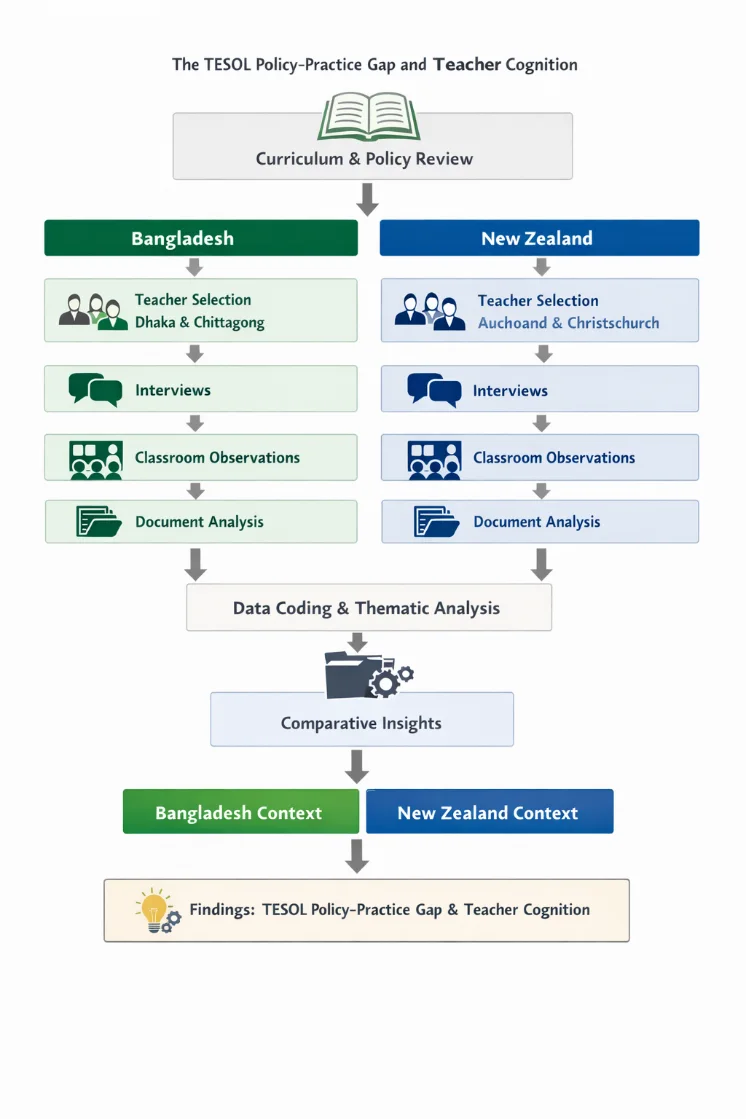
The research contrasts two different settings, i.e. Bangladesh and New Zealand in order to identify the common and context differences which influence the policy implementation of TESOL. This method emphasizes the interaction between institutional support, classroom conditions and sociocultural factors on teacher cognition and its impact on teaching practice. The study paradigm will be organized on the correspondence between curriculum goals, instruction and evaluation practices. The study explores the processes by which policy intentions are converted into classroom results by exploring the way these elements are perceived and operationalized by teachers. The design incorporates various sources of data such as interview, classroom observation and document analysis to offer well-rounded outlook in the policy-practice gap and its effects on successful English language teaching.
3.2 Participants and Sampling
This study was conducted on 200 TESOL teachers, 100 of them were of Bangladesh origin and 100 were of New Zealand origin. The participants were sampled through purposive sampling that enabled the researcher to select the teachers that have firsthand knowledge regarding the application of national TESOL curricula and classroom based English language teaching. Such sampling methodology has guaranteed that the sample had pertinent professional background and practical experiences to offer significant information regarding policy interpretations and applications in actual classes. This was to be selected based on active participation in the teaching of the English language, knowledge on national curriculum guidelines, and participation in regular classroom instruction at the secondary or higher secondary level.
The participants of Bangladesh were selected in two large educational centers of Dhaka and Chittagong. These cities are chosen as they are some of the main centers of secondary education and they offer various school settings where national English language policies are effectively practiced. Out of the Bangladeshi respondents, 60 teachers represented Dhaka and 40 teachers represented Chittagong. The teachers in this category worked in both the public and the private institutions as well since the education system in Bangladesh was dual. The public schools usually adhere to the guides of standardized governmental curriculum with a bigger number of students in classes and smaller resources whereas the private schools usually have a smaller number of students in classes and other instructional services. The inclusion of both sector teachers in the study enabled the researcher to include differences in institutional conditions that might contribute to the discrepancy between what the policy would anticipate and the classroom practices. The experience of the Bangladeshi participants in teaching was spread between 3 and 25 years with a mean of about 12.5 years, which guaranteed the inclusion of both the beginning teachers and the long-term teachers.
Table 1. Participant Distribution by Country, City, School Type, Teaching Experience, and Gender
| Country | City | Number of Teachers | School Type | Teaching Experience (years) | Gender (F/M) |
|---|---|---|---|---|---|
| Bangladesh | Dhaka | 60 | Public & Private | 3–25 (Mean = 12.5) | 33 / 27 |
| Bangladesh | Chittagong | 40 | Public & Private | 3–25 (Mean = 12.5) | 22 / 18 |
| New Zealand | Auckland | 55 | Urban & Regional | 4–30 (Mean = 15) | 32 / 23 |
| New Zealand | Wellington | 45 | Urban & Regional | 4–30 (Mean = 15) | 26 / 19 |
This distribution gives a variety of representation of institutional contexts, geographic areas, and professional experience which enhances the comparative character of the study. The sample is also fairly representative, incorporating a great variety of opinions on TESOL policy implementation and classroom practice because the teachers were chosen based on their city of work, type of school, and the number of years working in the field. This diversity makes this study more reliable and allows investigating in more depth the interaction between teacher cognition and curriculum alignment in various systems of national education.
3.3 Data Collection
To gather data to be used in this study, a triangulated method was employed, which comprised of semi-structured interviews, classroom observations and document analysis to generate an over-all picture of the policy implementation and teacher cognition in TESOL. This method enabled the research to represent the teacher, classroom-based, and policy-based perspectives and presented a multi-faceted picture of curriculum congruence in New Zealand and Bangladesh.
Semi-structured Interviews: Semi-structured interviews with all 200 teachers took about 60 minutes each. The interviews examined the beliefs of teachers, their knowledge, teaching methods and the interpretation of the national policies about TESOL. The questions were centered towards congruence between the desired outcomes of curriculum and the implementation by the classroom, and also the issues affecting effective teaching practices.
Classroom Observations: A sample of 80 teachers (40 Bangladesh, 40 New Zealand) was followed during 34 sessions of teachers where each session took about 45 minutes. The consistency of the teaching strategies, classroom activities and curriculum goals were observed. Issues of instructional strategies, classroom design, student engagement, and resource utilization were given special consideration.
Document Analysis: The analysis of 20 curriculum and policy documents involved the national TESOL frameworks and school-level instructions of teaching. The learning outcomes, suggested pedagogical methods, and assessment plans were also to be determined during the analysis, which would be used as a reference point when comparing the teacher-reported and observed classroom practice.
Table 2. Participant Involvement in Data Collection
| Data Source | Number of Participants | Sessions / Documents | Average Duration | Focus / Purpose |
|---|---|---|---|---|
| Semi-structured Interviews | 200 | 1 per participant | ~60 minutes | Explore teacher beliefs, knowledge, and curriculum interpretation |
| Classroom Observations | 80 (40 per country) | 3–4 per teacher | ~45 minutes | Examine alignment of classroom practice with curriculum objectives |
| Document Analysis | 20 | Policy & curriculum documents | Full review | Identify intended learning outcomes, pedagogy, and assessment alignment |
The table shows the comprehensive coverage of the participants and sources of data such that there is strong triangulation. Semi-structured interviews were able to measure teacher cognition in large scale, classroom observations in practice were validated, and document analysis set up policy benchmarks. Such a combination increases the validity and the richness of results.
The TESOL Policy-Practice Pathways flowchart offers the conceptual connection between the intentions of the curriculum, teacher cognition, and classroom implementation. It is based on constructive alignment theory and emphasizes how teacher interpretations mediate the policy into practice translation, revealing sequential stages in the implementation of the policy review and actual involvement of participants up to comparative analysis and identification of implementation gap.
3.4 Data Analysis
All the gathered data were analyzed with the help of thematic analysis to see the patterns, themes, and insights concerning the process of TESOL policy implementation and teacher cognition. Analysis was done to identify the processes involved in teacher interpretation and implementation of curriculum policies and to assess the consistency between the intended outcomes of learning and practices in classrooms.
Step 1: Data Preparation
Interview tapes were transcribed word-to-word and classroom observation notes were sorted together with policy and curriculum documents. All the text information was coded and organized in a consistent form to enable a systematic coding.
Step 2: Initial Coding
Preliminary coding scheme was created according to research goals of the study and oriented on three main areas:
Teacher cognition: perceptions, know-how and understanding about TESOL policies.
Curriculum congruence: conformity among planned results, instructional endeavors, and examinations.
Contextual factors: resources in classrooms, institutional support and sociocultural factors.
NVivo 14 was used to apply codes to the entire dataset, and together with both national contexts, recurrent concepts, practices, and issues were systematically tagged.
Step 3: Theme Development
Codes were categorized into higher order themes that represented trends in teacher cognition, curriculum implementation and situational limitations. Themes were repeatedly revisited and narrowed down to make sure that they reflected the data relevant and represented differences and similarities between Bangladesh and New Zealand.
Step 4: Comparison of Cross-Context
The comparison was done on the findings in the two countries to find:
Universal factors of policy-practice alignment.
Context-related issues which influence TESOL implementation.
The differences in teacher thinking and its impact on classroom practice.
Step 5: Acculturation with Theory
Results were explained within the constructive alignment theory which assumes that the effective learning happens when there is coherent alignment between the intended results, teaching activities and assessment. This theoretical perspective facilitated the explanation of mediating role of teacher cognition in policy implementation and emergence of discrepancies, which give an organized model of policy-practice gap.
Thematic analysis enabled a stringent, systematic review of huge qualitative data. Coding, theme development, and cross-context comparison help the study to identify general and situation-specific tendencies in policy implementation in the area of TESOL. Theory integration adds an explanatory level of understanding with the relationships between teacher cognition and classroom practice being explained by curriculum alignment and policy outcomes.
3.5 Ethical Considerations
The research was conducted in line with the rigorous ethical principles to guarantee the participants and the integrity of the research process. Ethical standards were met as all the participants gave informed consent before data were collected, and the objectives of the study, procedures, and other expectations were comprehensively explained. The participants were made aware that they were allowed to pull out of the study without any penalty or consequence. The anonymity and confidentiality were strictly upheld during the research. Transcripts taken during interviews, observation notes, and data records were depersonalized. Each set of data was safely deposited in password-secured systems, and the research team had access.
The appropriate institutional review boards of both Bangladesh and New Zealand gave ethical approval. The research design and the recruitment, data collection, and data storage methods followed the local and international research ethics stipulations when conducting a study on human subjects. Classroom observations and interviews sensitivity was given special attention. The teachers were also assured that their answers, and what happens in their classrooms are not going to be checked on the basis of performance and that the results will be given in a de-identified form. These steps made the research an ethical, responsible, and transparent one that would protect participants but allow gathering the valid and reliable data to study the TESOL policy practice gaps.
4. Results
4.1 Teacher Cognition: Instructional Decision-Making, Knowledge and Adaptive Strategies that Influence TESOL Policy Implementation
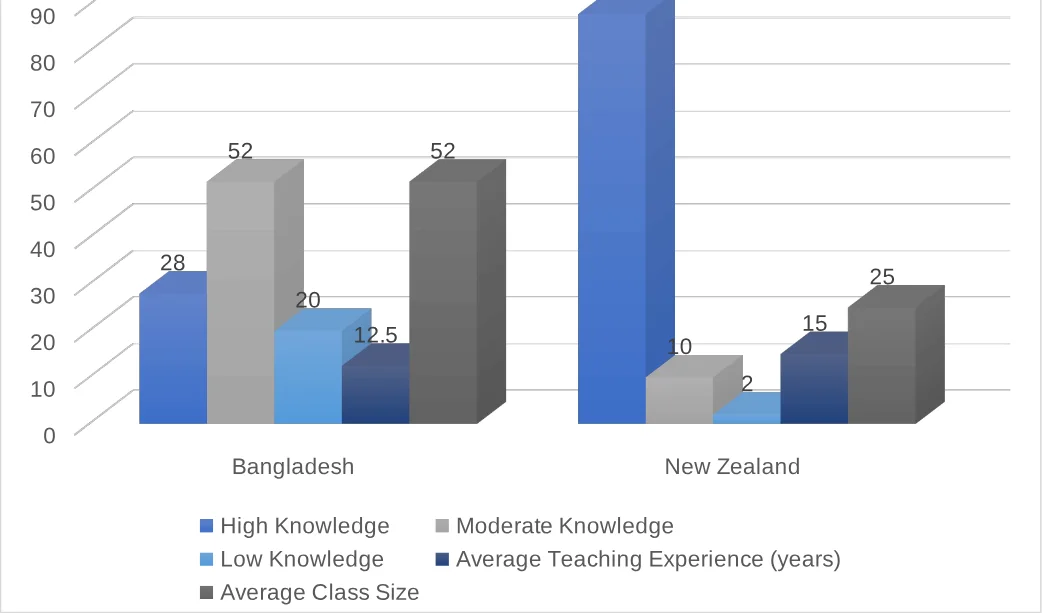
The TESOL curriculum implementation in Bangladesh and New Zealand was also heavily influenced by the teacher cognition. In Bangladesh, teachers had low awareness, moderate and high levels of understanding of the objectives of the curriculum with only 28% of teachers demonstrating high levels of understanding and 52% moderate levels of understanding. The classroom limitation of big classes (mean = 52 students), scarcity of instructional materials, and time containments saw most of the teachers adopting the communicative and learner-centered approach suggested by the curriculum; they used teacher-centered strategies. Teachers who were more than 15 years old had less knowledge about the policy as compared to the more experienced teachers.
New Zealand teacher cognition was overall high with 88% of teachers having high understanding, 10% moderate and only 2 low. The support of the institution, continuous professional growth, and availability of classroom resources allowed teachers to sustainably translate the goals of the curriculum into the practice. This comparison reveals that although teacher cognition is critical, there is contextual moderation, such as resources, class size, and support structures connecting the achievement of knowledge into effective classroom practice.
Figure 1 reveals that the proportion of teachers in New Zealand who have advanced knowledge of policies is higher, as they have smaller classes and institutional resources. In Bangladesh where some teachers were moderately to highly aware, structural restraints did not permit curriculum enactment and this was the reason explaining the broader TESOL policy-practice gap.
4.2 Curriculum Alignment: Consistency of Objectives, Instructional Plans and Evaluation
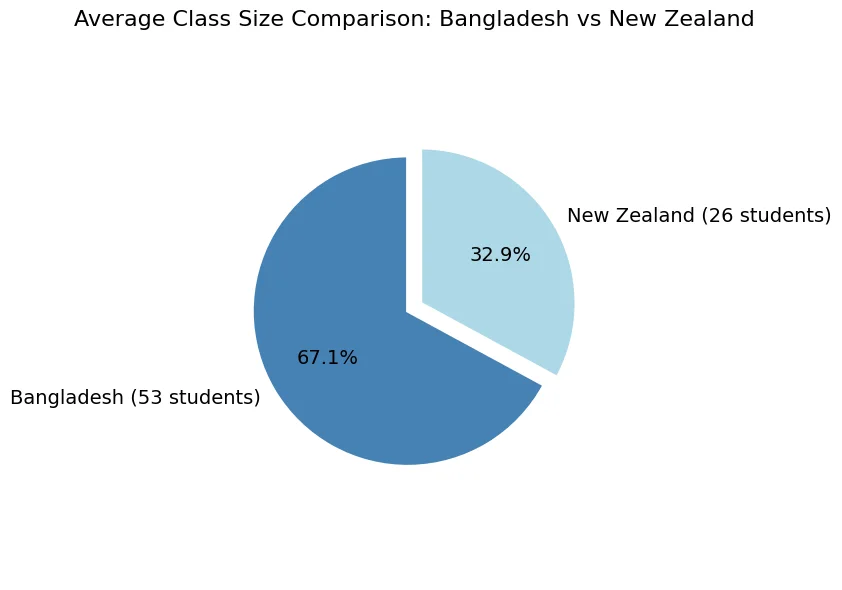
In Bangladesh and New Zealand, curriculum alignment as the consistency of the intended outcomes of the learning process, instruction and assessment practices was very instrumental in influencing the implementation of the TESOL policy. The classroom observations, interviews and policy document analyses demonstrated that there was notable difference in alignment between the two settings. The correspondence between the objectives of the lesson and national curriculum in Bangladesh was moderate, though only 36 percent of lessons included intended outcomes completely. The teaching practices were also based on syllabus coverage and examination-based teaching, where 62 percent of the lessons were mostly based on teacher-centered instruction like the lecture-based teaching approach, as well as grammar-translation assignment. Evaluations were based primarily on exam, and focused on remembering the facts but not communicative skills which gave a mean score of assessment of 3.1 (0.9) in all dimensions. There were structural limitations like big classes (mean 53 students), inadequate resources and unequal access to professional development which further restricted effective implementation of curriculum.
New Zealand, on the contrary, demonstrated good alignment of the curriculum. Lessons were also presented in the manner of intended learning outcomes approximately 85% of all lessons, and student-centered strategies were used in 78 of the lessons. Formative feedback, performance tasks and project-based evaluations were the assessment practices that were closely related to the lesson objectives. In New Zealand, mean alignment scores were 4.6 (±0.5) indicating that there was high levels of coherence existing between intended outcomes, teaching strategies and assessment practices. Implementing the curriculum was not difficult, as the small class sizes (mean = 26 students) and the support provided by the institution enabled the teacher to implement policy objectives in the classroom in a methodical way.
Table 3. Curriculum Alignment Scores and Classroom Metrics
| Country | Lesson Alignment (%) | Student-Centered Lessons (%) | Assessment Alignment (%) | Mean Alignment Score (1–5) | Average Class Size |
|---|---|---|---|---|---|
| Bangladesh | 36 | 38 | 32 | 3.1 ± 0.9 | 53 |
| New Zealand | 85 | 78 | 82 | 4.6 ± 0.5 | 26 |
The table shows that the Bangladesh and New Zealand have significant differences in the curriculum alignment. The structural and contextual barriers in Bangladesh constrained policy and practice congruence and in New Zealand, high scores in the algebraic scores of coherences suggest the collective impact of teacher cognition, institutional support, and smaller classes. These findings demonstrate that teacher knowledge and contextual conditions are both important in mediating the TESOL policy-practice gap.
4.3 Classroom Practice: Noticed Approaches to Instruction and Student Interaction
Both teacher cognition and contextual constraints in the countries were expressed in classroom practice in TESOL settings. The use of 80 teachers (40 Bangladesh and 40 New Zealand) showed that there is evident variance in the way of instruction, student involvement, and curriculum objectives.
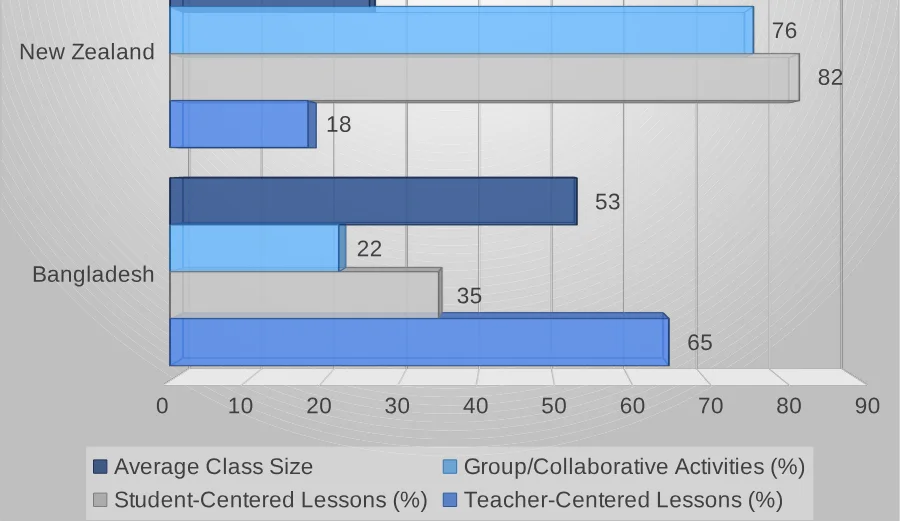
In Bangladesh, the classes were more teacher centered. Approximately, 65 percent of lessons were lecture-based, and there was little room to interact or engage in communication as a student. There was a lot of passivity among students and team or project learning was seldom seen. Huge class sizes (mean = 53 students) limited interaction teaching even in cases where teachers knew communicative curriculum objectives. In many cases, teachers claimed to improvise in order to control the lesson and focus more on syllabus coverage or test preparation as opposed to ensuring that the students develop a skill.
In New Zealand, the schools used a student-centered style in their classrooms, 82 percent of lessons included interactive tasks, group work and performance tasks. The teachers were involved in connecting instructions to the educational goals, and through formative feedback, they assisted students in learning. The ability to engage with the students and the teachers was achievable through smaller class sizes (mean = 26 students), which enabled teaching competency-based instruction. It was observed that New Zealand teachers often implemented strategies to address the requirements of the different learners so that there was a high degree of conformity between the policy intentions as well as the classroom practice.
As shown in the figure, the structural factors that dominate the classroom practice in Bangladesh are large classes and insufficient resources which leads to teacher-centred instructions. Small classes and institutional resources in New Zealand make them more aligned with the curriculum goals, with smaller classes facilitating the use of student-centered and interactive practices. These results demonstrate that teacher thinking and the contextual support influence the effective classroom practice and mediate the TESOL policy-practice gap.
4.4 Institutional Support, resources and Class size Contextual Factors
The contextual factors such as the size of the class, availability of resources, and institutional support were important in the development of the TESOL policy implementation in Bangladesh and New Zealand. These aspects affected the practice of teachers to match the goals of the curriculum and had an influence on the policy-practice gap in both situations.
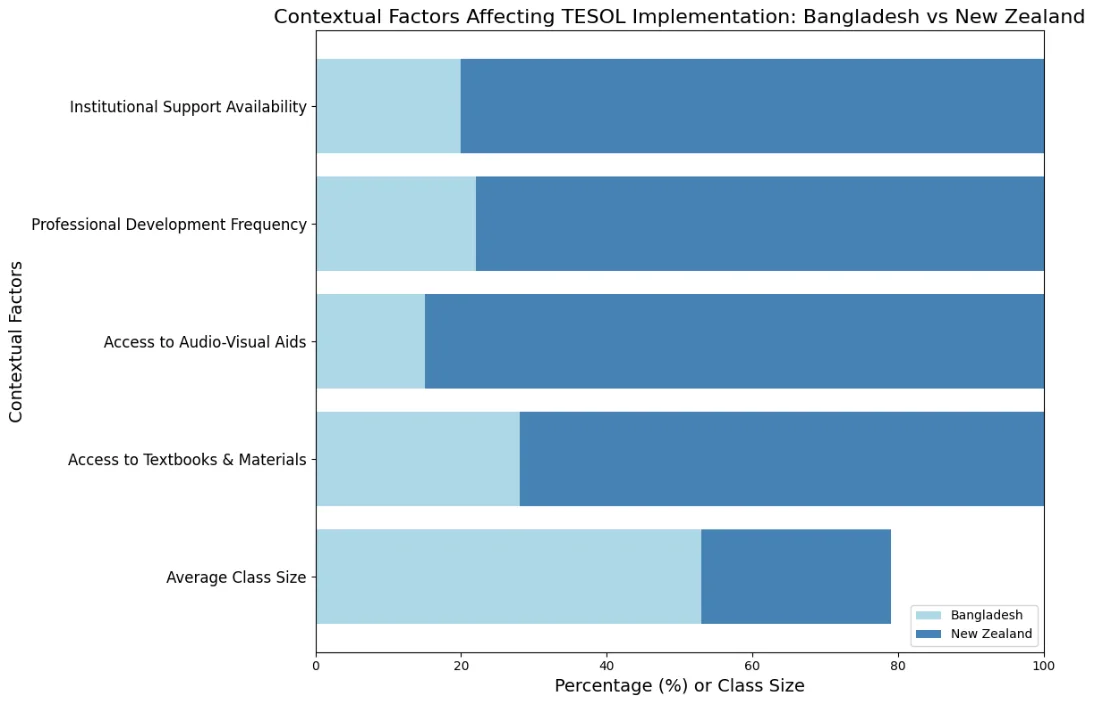
In Bangladesh, teachers faced significant obstacles since the classes had large sizes (mean = 53 students) and thus prevented them to adopt student-centered teaching methods. Also, teaching materials were not available: only 28 percent of educators said they had access to textbooks, and only 15 percent had access to audio-visual materials. Further, there was little institutional support and only 20 percent of teachers reported having frequent access to mentoring or collaborative planning. There was not much professional development and only 22 percent of the teachers took formal training during the last two years. All these restrictions played a role in dependence on teacher-centered lessons, which are syllabus based and exam preparation centered as opposed to communicative or competency-based lessons.
New Zealand teachers, on the contrary, enjoyed the advantage of smaller classes (mean = 26 students) where they could teach students more effectively. Accessibility to resources was also high with 92% of the teachers reporting that they have access to textbooks, 88% of teachers reported that they have access to audio-visual aids. The level of institutional support was high, 88% of teachers were regularly mentored, given a chance of collaborating on planning and opportunities of professional development. These positive conditions allowed New Zealand teachers to use interactive and competency-based teaching methods, which led to a better compliance with the curriculum goals.
The figure highlights significant differences in the contextual factors between Bangladesh and New Zealand. The majority of TESOL practices are teacher-centered in Bangladesh due to the large classes and the lack of access to resources and effective policies to implement policies that can help achieve the desired outcomes. Higher instruction and a student-centered teaching approach are the conditions in New Zealand due to smaller class size, a high number of resources, and solid institutional support, which makes teaching in this state the best in terms of meeting the goals of the TESOL curriculum. These results show how important the contextual factors play in closing policy practice gap during the TESOL practice.
4.5 Cross-Country Comparison and Policy–Practice Gap
In contrasting policy implementation in TESOL in both Bangladesh and New Zealand, the role of teacher cognition, classroom practices as well as contextual factors in the policy practice gap is highly highlighted. The results demonstrate how the structural issues such as the size of the classes, the availability of resources, and the support provided by the institutions influenced the capacity of the teachers in both the countries to match and be able to carry out the TESOL policies. Large classes (mean = 53 students) and few resources (28% can access textbooks, 15% can access audio-visual aids) were the structural barriers to the implementation of curriculum objectives by teachers in Bangladesh. The institutional support was not high and, only 20 percent of teachers had access to mentorship or even collaborative planning. Therefore, the use of teacher-centered methods was in the majority, 65 per cent of the lessons were lecture-based. New Zealand, in its turn, had an advantage of small classes (means = 26) and high access to resources (92% of students accessing textbooks, 88% to audio-visual aids) and made it possible to use a more student-centered teaching approach (82% of the lessons) facilitated by institutional support (88% of teachers reported having access to mentorship and professional development).
Table 4. Cross-Country Comparison of Teacher Knowledge and Curriculum Alignment
| Indicator | Bangladesh | New Zealand |
|---|---|---|
| High Policy Knowledge (%) | 28 | 88 |
| Student-Centered Lessons (%) | 35 | 82 |
| Teacher-Centered Lessons (%) | 65 | 18 |
| Lesson Objectives Alignment (1–5) | 3.2 ± 0.8 | 4.7 ± 0.4 |
| Teaching Methods Alignment (1–5) | 3.0 ± 0.9 | 4.6 ± 0.5 |
| Assessment Alignment (1–5) | 2.8 ± 1.0 | 4.5 ± 0.6 |
As described in the table, Bangladesh reflects the moderate correspondence of policy knowledge and classroom practice, with most of the practices being based on the teacher-centered approaches. The high educator cognition levels in New Zealand, combined with the reduction in class size and institutional assistance, lead to a high level of conformity between the lesson goals, instructional practices, and evaluation techniques. This extreme comparison of the two nations highlights the importance of institutional support and resources in ensuring effective implementation of policies.
This chart brings out the contextual differences between Bangladesh and New Zealand. In Bangladesh teachers are highly constrained in their structural aspects by huge classes, low accessibility to resources, and minimal support of the institutions they work in and they are unable to make their teaching practices consistent with the goals of the curriculum. On the other hand, teachers in New Zealand enjoy smaller classes, high levels of resources, and strong institutional support that enhances effective implementation of policies of TESOL and increase of curriculum alignment.
The critical importance of contextual factors in highlighting the policy practice gap is revealed in this cross-country comparison. However, the issues surrounding the size of classes, the resources available, and the support structures in Bangladesh are important causes of the increased gap whereas in New Zealand, the environment is favorable to allow more policy-practice alignment. These results hold that institutional support, volume of the classroom and availability of resources are significant external structural factors that are necessary to achieve successful translation of TESOL policies into successful classroom practice.
5. Discussion
The results of the current research support the notion of the multidimensional essence of the TESOL policy-practice gap, specifically how teacher cognition, curriculum alignment, and contextual circumstances take central roles in the policy implementation in Bangladesh and New Zealand. The research demonstrates that although the two nations have similar interests towards the development of communicative competence and learner-centred pedagogies, the success of TESOL policies in fulfilling the roles and objectives largely depends on contextual elements which include the size of classes, availability of resources, and the support of institutions.
Teacher cognition has become one of the key elements that determine TESOL policy implementation in the two countries. Knowledge and beliefs of teachers regarding the curriculum and pedagogy played a major role in the discrepancy between the intended results and the classroom practices. In Bangladesh, policy knowledge among a significant percentage of teachers was moderate and low with the high population in classes, inaccessibility to resources, and institutional support. It caused this knowledge and resource gap in teachers, resulting in a teacher-centered style of 65 percent of lessons that is in line with the results of other resource-limited situations (Rahman and Ahmed, 2024). However, in New Zealand, teacher cognition levels were high and they were supported by a strong institutional policy which made there to be a more stable consistency in the alignment of policy between lesson goals, teaching practices and assessment. Such discrepancy highlights the role of teacher training and institutional help in the difference between the policies and classroom practices.
Curriculum alignment in New Zealand was significantly greater with 85 percent of lessons being demonstrated in the intended learning outcomes. The prevalence of Teacher-centered lessons was observed in Bangladesh where merely 36% of the lessons were in line with national curriculum objectives. The high student populations in Bangladesh, which made the average classes size 53 students, were very detrimental to the interactive, student-centered methods as promoted by the national curriculum. Smaller class sizes and high availability of resources in New Zealand in contrast to the situation in the United States provided the opportunity to use the student-centered approach to teaching, proving that the conditions in the classroom are important in putting curriculum into practice. Further, there was a low provision of professional development opportunities (22%) and institutional support (20%), which worsened the situation in Bangladesh as teachers were not able to internalize or practice the reforms in their curriculum. New Zealand, on the other hand, was lucky to have sustained professional development (85%) and a good institutional support (88%) that enabled teachers to be adaptive and also to effect a curriculum reform with success. Herein lies the necessity of a continuous growth of the profession that will address the discrepancy between the beliefs held by teachers and the requirements of the new curricula.
6. Conclusion
This study has shown that the contextual variables, which include the size of the classroom, the availability of resources, and the institutional support, are important in dictating the manner in which TESOL policies are acted out in the classroom. In Bangladesh, a high population of students in classes, inadequate resources, and institutional weak support were some of the factors that led to failure in the implementation of TESOL policies, which resulted in a high policy-practice gap. Educators were compelled to use the teacher-centered methods, which were contrary to the student-centered curriculum.
On the contrary, the positive environment provided in New Zealand, such as smaller class sizes, availability of resources, and the presence of institutional support, enabled a more successful match between the planned curriculum and classroom practices. Such positive aspects facilitated the successful introduction of TESOL policies and achievement in learning.
The research demonstrates the significance of considering teacher thinking as well as the external structural system that shapes policy implementation. In resource-bound settings such as Bangladesh, the focus of the reform should be in capacity building of teachers, allocation of more resources and institutional reinforcement. Such interventions would assist in closing the policy-practice gap and better classroom alignment of the curriculum.
7. Recommendations
In an attempt to mitigate the policy practice gap in TESOL, a number of recommendations can be offered. To begin with, Bangladesh needs to invest in continuous professional growth of teachers, which should be aimed at the curriculum alignment and student-centered learning. This may be done by having frequent workshops and peer work to help the teacher to modify their practices in accordance to the curriculum goals. New Zealand can still go on with the professional development programs but this time around with a focus of addressing the needs of the culturally diverse students and adopting new teaching methods that can help sustain teaching excellence.
Second, there is need to enhance access to resources. Classroom materials, including textbooks, audio-visual and technological should be invested in particularly in rural and underfunded regions of Bangladesh. To enhance interactive learning and involvement of the students, New Zealand ought to provide equal access to digital learning resources in schools, especially in the remote areas. Third, it is important to improve institutional support. In an attempt to enhance the capacity of teachers to execute curriculum, Bangladesh needs to adopt mentorship programs and promote joint planning. In New Zealand, the development of peer mentorship and collaborative development will improve the quality of teaching in different school environments and guarantee equal implementation of the policies. Lastly, curriculum flexibility should be achieved in the two countries. In Bangladesh, educators should be provided with additional freedom to modify lessons according to the classroom requirements and resources. The curriculum in New Zealand needs to be accommodative and must be flexible to cultural and language diversity and student outcomes must be valued and assessments should be in tandem with the individual ability.
With the emphasis on teacher development, resources, institutional support, and curriculum flexibility, both nations can close the policy-practice gap and enhance the implementation of the TESOL policy, which will result in a higher learning outcome among students.
Reference
Abedi, Emmanuel Ayisi. 2024. “Tensions between Technology Integration Practices of Teachers and ICT in Education Policy Expectations: Implications for Change in Teacher Knowledge, Beliefs and Teaching Practices.” Journal of Computers in Education 11(4):1215–34. doi:10.1007/s40692-023-00296-6.
Acharya, Ramji. 2025. “English Language Education & Assessment Policy In Nepal.” Education Science & Technology. doi:10.3459/2025/ST7.
Bashir, Noha. 2024. “Teachers’ Perceptions of Shifting from Traditional Exams to Creative Student Responses: A Study of the Bangladeshi Education System.” Thesis, AUW.
Brock, Antje, Eva-Maria Waltner, and Darren Rabinowitz. 2025. “Cross-Disciplinary Perspectives on Developing Global Datasets and Indicators for Monitoring Climate Change Education and Communication (CCE).” Discover Sustainability 6(1):1390. doi:10.1007/s43621-025-01763-z.
Correia, Nadine, Tiago Almeida, Rita Friães, and Adriana Cardoso. 2025. “Bridging Pedagogy, Curriculum, and Assessment in Digital Education: Ensuring a Constructive Alignment | Article | Social Inclusion.” https://www.cogitatiopress.com/socialinclusion/article/view/9473.
Imam, Md Sartaz, and Naim Al-Mahmud. 2024. “Transforming English Language Teaching (ELT) in Bangladeshi Primary Schools: Challenges and Strategic Solutions.” ICRRD Quality Index Research Journal 5(3). doi:10.53272/icrrd.v5i3.6.
Jones, Philippa R. n.d. “Teaching Aotearoa New Zealand’s Histories: Teacher Sensemaking of a Policy Implementation.”
Ketonen, Laura, and Juuso Henrik Nieminen. 2025. “Professional Autonomy vs. Assessment Criteria: Teacher Agency in the Midst of Assessment Reform.” Journal of Curriculum Studies 0(0):1–18. doi:10.1080/00220272.2025.2460476.
Krulatz, Anna, MaryAnn Christison, Eliane Lorenz, and Yeşim Sevinç. 2024. “The Impact of Teacher Professional Development on Teacher Cognition and Multilingual Teaching Practices.” International Journal of Multilingualism 21(2):711–27. doi:10.1080/14790718.2022.2107648.
Luo, Xue, Bity Salwana Alias, and Nor Hafizah Adnan. 2024. “Exploring the Interplay between Teacher Leadership and Self-Efficacy: A Systematic Literature Review (2013–2024).” Education Sciences 14(9):990. doi:10.3390/educsci14090990.
Marzaini, Anwar Farhan Mohamad, and Shahazwan Mat Yusoff. 2025. “Malaysian ESL Teachers’ Instructional Planning in CEFR-Aligned Classroom Based Assessment.”
Nazari, Mostafa, and Sedigheh Karimpour. 2023. “Emotions, Perspectives, and English Language Teacher Identity Construction: A Phenomenographic-Narrative Study.” International Journal of Applied Linguistics 33(2):150–68. doi:10.1111/ijal.12455.
Saleem, Muhammad, and Junaid Khan. 2024. “TESOL in Transition: Local Challenges and Global Influences.” Wah Academia Journal of Social Sciences 3(2):950–68. doi:10.63954/WAJSS.3.2.52.2024.
Vu, Thao, and Lan Thi Huong Nguyen. 2025. “Navigating English Curriculum Reform in Vietnam: A Socio-Cultural Perspective on Teacher Perezhivanie and Agency.” Curriculum Perspectives. doi:10.1007/s41297-025-00315-9.
Yazan, Bedrettin. 2022. “A Conceptual Framework to Understand Language Teacher Identities.” Second Language Teacher Education 1(2):185–208. doi:10.1558/slte.24908.
Zufi, Arif. 2024. “Policy, Perception, and Practice: EFL Teachers’ Perspectives on the Implementation of the Communicative Language Teaching Approach in Bangladeshi Secondary Education.” doctoral, University of East Anglia.

CITE THIS ARTICLE
Sultana, S. (2026). The TESOL Policy–Practice Gap: Curriculum Alignment and Teacher Cognition in Bangladesh and New Zealand. https://www.researchbysayma.com/article/58e6b493-d40d-4410-aecb-b8d6e3fb13cc
S. Sultana, “The TESOL Policy–Practice Gap: Curriculum Alignment and Teacher Cognition in Bangladesh and New Zealand,” 2026. [Online]. Available: https://www.researchbysayma.com/article/58e6b493-d40d-4410-aecb-b8d6e3fb13cc
Sultana, S. (2026) ‘The TESOL Policy–Practice Gap: Curriculum Alignment and Teacher Cognition in Bangladesh and New Zealand’. Available at: https://www.researchbysayma.com/article/58e6b493-d40d-4410-aecb-b8d6e3fb13cc
Sultana, Sayma. “The TESOL Policy–Practice Gap: Curriculum Alignment and Teacher Cognition in Bangladesh and New Zealand.” 2026, https://www.researchbysayma.com/article/58e6b493-d40d-4410-aecb-b8d6e3fb13cc.
Sayma Sultana. “The TESOL Policy–Practice Gap: Curriculum Alignment and Teacher Cognition in Bangladesh and New Zealand.” (2026). https://www.researchbysayma.com/article/58e6b493-d40d-4410-aecb-b8d6e3fb13cc.
Sultana S. The TESOL Policy–Practice Gap: Curriculum Alignment and Teacher Cognition in Bangladesh and New Zealand. 2026. https://www.researchbysayma.com/article/58e6b493-d40d-4410-aecb-b8d6e3fb13cc
@misc{article_58e6b493d40d4410aecbb8d6e3fb13cc,
  title = {The TESOL Policy–Practice Gap: Curriculum Alignment and Teacher Cognition in Bangladesh and New Zealand},
  author = {Sayma Sultana},
  year = {2026},
  url = {https://www.researchbysayma.com/article/58e6b493-d40d-4410-aecb-b8d6e3fb13cc},
}
TY - GEN AU - Sayma Sultana TI - The TESOL Policy–Practice Gap: Curriculum Alignment and Teacher Cognition in Bangladesh and New Zealand PY - 2026 UR - https://www.researchbysayma.com/article/58e6b493-d40d-4410-aecb-b8d6e3fb13cc ER -