The spread of English in the world has led to the threat of the traditional domination of the Standard English in teaching the English language (ELT). This paper examines the views of English language teachers in Bangladesh towards Standard English and the ways they use Global Englishes perspectives in their classrooms. A qualitative exploratory research design was used to gather information on 150 English language teachers in the secondary or university level in Bangladesh. The beliefs of teachers, classroom practices and pedagogical decision-making processes were investigated with the help of a structured questionnaire and semi-structured interviews.
According to the results, 64% of the teachers believe that Standard English is the main model used in ELT classrooms because of the curriculum and exam systems, which prioritize the standardized norms of the language. Simultaneously, the findings demonstrate the growing awareness of the international variety of English. About 46% of teachers stated that they sometimes use multimedia materials, listening activities and classroom discussions to introduce students to the contexts of world communication by introducing them to the use of various accents or varieties of English.
The research also emphasizes the presence of teacher agency in the classroom practices. Although most teachers are receptive to the incorporation of Global Englishes views, institutional forces like curricular programs and assessment programs tend to restrict the scope of application of such views. Because of this, in many cases teachers have been convinced to take a middle way where Standard English is the main instructional model, with small exposure to other forms of English provided by way of supplementary activities.
In general, the results indicate that the pedagogical implementation of Global Englishes in Bangladesh is slowly developing but needs to be supported at the institutional level. To implement Global Englishes in ELT, teacher training, curriculum and testing approaches will have to be reformed in order to more accurately reflect the global realities of English language use.
The internationalization of the English language has made it one of the commonest languages of communication across the globe. Nowadays, English is not only spoken by people who have it as the mother tongue, but it is also used by millions of multilingual people in various parts of the world. This generalization has begun to question the traditional concept of Standard English, which in the past has placed native-speaker varieties of English like British or American English as the ideal varieties in language teaching. Apple Linguistics and English Language Teaching (ELT) scholars are raising more and more objections that these models are not sufficiently reflective of realities of global English use, which are complex and diverse(Rose and Galloway 2019).
Subsequently, where Global Englishes have become prominent over recent years in response to these changes. The Global Englishes approach acknowledges that English has developed as various forms depending on various linguistic, cultural, as well as social settings. Instead of giving privilege to the native-speaker norms, this strategy focuses on mutual intelligibility, intercultural competence, and communicative effectiveness between the speakers with different backgrounds(Boonsuk 2026). With the increasing role of English language use as a lingua franca in global exchange, researchers suggest that English language teaching should rethink the hegemony of standardized form and to include a wider conceptualization of English diversity (Gandana and Hamied 2025).
Although academic debates about Global Englishes have been on the rise, numerous educational systems still preserve the tradition of the native-speaker norms in their curriculi and methods of instruction. Educational policies, textbooks, and tests in different countries which teach English as a foreign language or as a second language often promote the standardized models of the English language. Bangladesh is one of such contexts where English is being very important both in education, employment, and communication with the rest of the world. Nevertheless, ELT practices in Bangladesh can be said to be mostly conforming to traditional norms that favor British or American English which might not always be a complete representation of the realities of multilingual and multicultural orientation of teaching English in the international arena(Guo and Sidhu 2024).In this regard, teachers can be seen as playing a pivotal role of intercession of the curriculum expectations and reality in classrooms. Educational policies do not simply entail passive implementation by teachers, they interactively interpret and adjust pedagogical practices according to their beliefs, experiences and local teaching settings. This professional decision-making ability is also often referred to as teacher agency, which is essential in deciding whether new pedagogical views are accepted or not introduced into the classroom practice(Ashton 2022).By being agency, the teachers have the potential to defy the set norms and provide new and more appropriate means of operations that are more reflective of the modern realities of language.
In spite of increased theoretical debate on Global Englishes over the last few years, in most cases, the practical application of the theoretical concepts in classroom teaching is still low. Relatively, there is limited research that has investigated the understanding of the English language teachers in Bangladesh in terms of Global Englishes and their perceptions in terms of classroom practice and how their beliefs impact on classroom practices. The views of teachers are of special interest to understand since they are among the major players in implementing the educational theories into practice. Exploring teacher agency can thus be an informative source of information concerning the ways in which the norms of Standard English can be reconsidered and Global Englishes thinking can find its way into the classroom life incrementally. It is against this background that this research paper explores the concept of decentring the English language teaching in Bangladesh, as applied by English language teachers. In particular, it examines the ways in which teachers conceptualize the idea of Global Englishes, and the manner in which the professional agency influences the pedagogical implementation of these ideas. The proposed study is expected to produce the following contribution to the current discourse on the creation of more inclusive and contextually appropriate methods of teaching English language in Bangladesh and other educational settings.
2.Literature Review
2.1 The spread of English across the world and the shift of attitudes toward ELT
The diffusion of the English language all over the world has been a major catalyst in changing the conceptualization and instruction of the language. In the past, English language teaching (ELT) has been significantly based on the norms of native speakers allied to the types of Standard English like the British or American English. Nonetheless, the quick growth of the numbers of English users around the globe has questioned the fact that the varieties can be the sole example of language teaching. Applied linguists maintain that English is now a global language spoken by the members of various linguistic and cultural groups. This has led to the change in thinking among researchers where they have come to view the traditional ELT frameworks differently and to acknowledge the heterogeneity of English in international communication(Heidari Tabrizi and Chalak 2025).
The study of English as a global language demonstrates the way the language has grown beyond the range of the native speaking nations and is currently very popular in mulilingual environment. Research has also highlighted that English language teaching ought to be flexible to the realities of worldwide communication as opposed to prioritizing the native-speaker norm (Salomone and Salomone 2022). Also, the study of English as lingua franca has shown that effective communication is usually based on mutuality, as opposed to compliance to the norms of the native speakers(Kopchak et al. 2022).
2.2 World Englishes and the acceptance of linguistic diversity
The idea of World Englishes has been significant in appreciating the diversity of English in the various sociolinguistic settings. The model proposed by Kachru, known as the three concentric circles: Inner Circle, Outer Circle and the Expanding Circle shows how English has acquired various varieties in various parts of the globe(Monfared and Najjarbaghseyah 2023). This paradigm in question targets the idea that native-speaker varieties are supposed to be the primary reference point in teaching languages. Following studies have emphasized on the sociocultural importance of localized forms of English and the role they play in international communication(Moody 2024). The academic community has also analyzed the way the various versions of the English language manifest the historical, cultural and social influences in diverse settings(Syam, Seli, and Abdu 2023). Additional research has shown how English still changes as it is implemented into new linguistic contexts, and new varieties and types of use were created (Liu and Wang 2024).
2.3 Global Englishes and implications on language teaching
Based on the idea of World Englishes, the concept of Global Englishes has widened the debate regarding the place of English in global communication. Global Englishes stresses that English is often a lingua franca spoken by people who do not speak the same language as the first language (Chen 2022). This view disputes the classic aspiration of the process of language acquisition to native proficiency. Rather, researchers believe that instruction in languages ought to be aimed at communicative competence and communicative interaction in multilingual contexts(Alsolami n.d.).The significance of intelligibility and mutual understanding in international communication is also known in research about English as lingua franca (Gandana and Hamied 2025). Also, research has added that teaching languages ought to capture the realities of global use of English and equip learners to converse with speakers of other languages(Selvi, Galloway, and Rose 2023).
2.4 Teacher beliefs and ELT teacher agency
The beliefs and professional autonomy of teachers are very important in determining the classroom practices. Teacher agency is a widely debated concept that has been used as a rubric to explain the way teachers comprehend and put into practice educational policies and curricula. Teacher agency is the ability of teachers to make informed pedagogic decisions in specific institutional settings (Cong-Lem 2024). Teacher cognition studies have revealed that beliefs, experience and professional knowledge of teachers have a powerful impact on the instructional practices (Li and Ma 2025).Research carried out on ELT settings suggests that teachers tend to be aware of the diversity of the English language, yet they can still adhere to the traditional models of language because of the institutional requirements(Boonsuk and Karakaş 2025). Moreover, pedagogical studies demonstrate that educators constantly engage in the negotiation of curriculum demands and their professional discretion in course of implementing classroom activities(Larsen 2024).
2.5 ELT situation in Bangladesh and gaps in research
In the South Asian setting like the one in Bangladesh, English has a complicated role as a medium of education, international communication and social mobility. Nevertheless, ELT systems in the area often focus on standardized versions of English that are an inheritance of colonial educational cultures(Yan and Ruan 2024) . The studies revealed that grammatical correctness and performance in the exams is prioritized over communicative competence though English language teaching in Bangladesh (Rokaiya and Saharuddin 2022). Research has also brought challenges to do with big sizes of classes, lack of teacher training as well as teaching resources in the practice of communicative language teaching(Nam 2023). Other studies have also explored the effect of institutional and sociocultural conditions on the English language teaching practices country(Neupane 2024). Newfound research indicates that it might be effective to integrate Global Englishes perspective in teacher education programs to enable teachers to be more responsive to the realities of global communication(Alam and Mohanty 2023). However, the empirical research that analyzes the perceptions and applications of Global Englishes views by teachers in Bangladesh is scarce, which means that more research should be carried out in this field.
3.Conceptual Framework
An approach that enables the framing of this study states that the Global Englishes perspectives shape classroom practices in English language teaching (ELT) by means of the belief and professional agency of teachers. In the modern Applied Linguistics, researchers underline the fact that English is the global language spoken by people with various linguistic and cultural origins. Consequently, there has been a growing challenge to the conventional use of Standard English as the only model of language teaching.
In this context, Global Englishes orientations shape the perceptions of teachers towards standards of English language, especially the significance of native speakers standards, intelligibility, and exposure to different forms of English. Such beliefs are significant in determining the practices in classes since they influence the way the educators perceive the curricular requirements and make teaching choices. Nevertheless, the instructional practices are not directly dependent on the beliefs of teachers.
The notion of teacher agency describes how teachers constructively perceive curricula, reformulate teaching resources, and pedagogical choices on institutional and classroom levels. Teachers can present the examples of various versions of English, discuss the context of communication on the global level, or underline the communicative efficiency instead of following the norms of native speakers, through their professional agency. These are the pedagogical appropriation of Global Englishes outlooks in ELT classrooms.
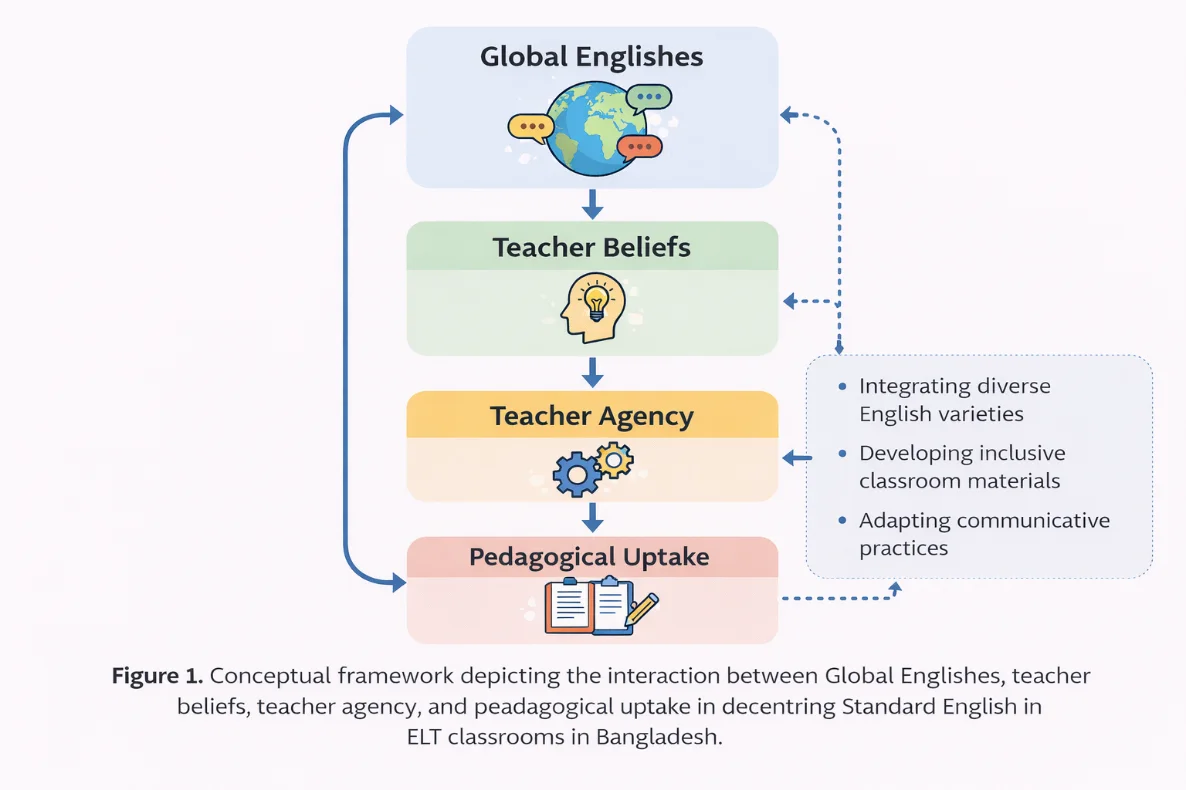
These elements have a relationship that has been depicted in Figure 1 that demonstrates how Global Englishes perspective can influence the belief of teachers, how the belief can affect teacher agency and how agency eventually will lead to the realization of Global Englishes in classroom pedagogy.
Figure 1.Relationship between Global Englishes, teacher beliefs, teacher agency, and pedagogical uptake in ELT.
The model demonstrates how the perspective of Global Englishes can shift the views of teachers concerning the beliefs about the norms of language. These ideologies determine the ways in which teachers can be able to exercise agency in modifying the teaching methods and this goes on to influence the degree to which Global Englishes viewpoints are incorporated into classrooms.
4.Methodology
4.1 Research Design
The study has a qualitative exploratory research design to examine the nature of the perceived dominance of Standard English by English language teachers in Bangladesh and how they align Global Englishes approaches to classroom instruction. The choice of a qualitative approach is that the study aims at investigating the beliefs, experiences, and processes involved in the pedagogical decision-making of teachers on a deeper level as opposed to quantifying predetermined variables. The application of qualitative research is quite common in Applied Linguistics to study the complex educational phenomena in the particular sociocultural setting. The research involves the mediation of the association amid conventional Standard English traditions and emerging views related to Global Englishes, which is facilitated by teacher agency. Through teacher perception and practice, the study will be trying to know how teachers interpret the expectations of the curriculum and whether they incorporate different forms of the English language in the teaching process or not.
Bangladesh is the location of the study and English is very important in education, higher education, and international communication. Despite introduction of communicative language teaching in the national curricula, in the classrooms, instruction still tends to follow the British or American norm of the English language. This situation offers an appropriate setting in which to study the reaction of teachers to the changing world attitude towards the use of English language.
The research sample will be English language teachers in the secondary school and university of Bangladesh. These are the teachers who constitute the prime stakeholders in the implementation of the English language teaching practices in the classrooms. The study specifically targets teachers with professional experience on teaching English language courses and those teachers who play a part in providing curriculum-based instruction. A population study will enable the study to take the views of teachers regarding the English varieties, the teaching pedagogy used in the classroom, and the degree of agency used by the teachers to change the teaching methods.
The research design allows exploring the issue of teacher negotiation and agreement with the expectations of the institutions and traditional language norms and the increased awareness of English as a worldwide and multidimensional language.
4.2 Participants and Sampling Procedure
In this study, purposive sampling was used to select the participants that are currently active in teaching the English language and are able to give informed views about the application of Standard English and Global Englishes in classrooms. Purposive sampling was deemed suitable due to the fact the study is concerned with the professional experiences of teachers, their beliefs and pedagogical practices in regards to teaching English language.
There were 150 English language teachers involved in the research. Sampling was done at the secondary schools and universities in Bangladesh including the public and the private schools. The choice of teachers used in the study based on the various educational settings enabled the study to emerge with a wider perspective of views concerning the English language teaching practices and institution expectation with respect to language norms.
The following inclusion criteria were used to select the participants:
Teaching English language in Bangladesh.
Two years of experience in teaching (minimum)
Instructing at secondary or tertiary level of education.
Consent to take part in the study on a voluntary basis.
The teachers were approached based on institutional communication methods, professional networks, and through academic contacts and those who volunteered to join the study were incorporated in the study. The sample size was rather large which allowed the study to get a wide range of professional views and still be detailed enough to supply a qualitative analysis.
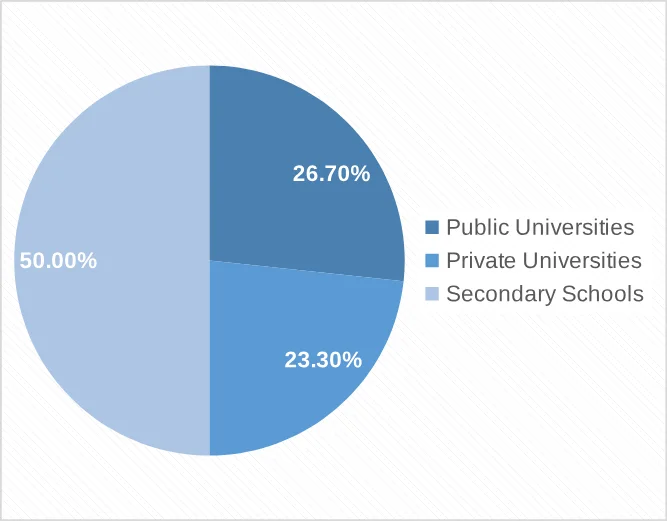
One hundred and fifty English language teachers were involved in the research. Out of them, 75 were secondary school teachers who were the largest representation of the sample. Moreover, 40 respondents belonged to the public universities, and 35 respondents belonged to the private universities.
As shown in Figure 2, the teachers in secondary schools were 50 % of the participants, public universities 26.7%, and the 23.3% of the participants were in the private universities. This was spread so that both the secondary and the tertiary levels of English language teaching in Bangladesh were represented in the study.
Figure 2.Distribution of Participants by Institution Type
Table 1. Demographic Characteristics of Participants
Variable
Category
Frequency
Percentage
Gender
Male
68
45.3%
Female
82
54.7%
Teaching Experience
2–5 years
42
28.0%
6–10 years
58
38.7%
11–15 years
32
21.3%
More than 15 years
18
12.0%
Academic Qualification
MA in English
92
61.3%
MA in Applied Linguistics
38
25.3%
Other related fields
20
13.4%
Table 2 is a summary of the demographic profile of the participants, such as gender distribution, teaching experience, and academic qualifications. The respondents have a wide scope of professional experiences, and teaching careers, which enables the study to elicit different views on the norms of the English language and teaching methods.
4.3 Data Collection Methods
A structured questionnaire and semi-structured interview were used to gather quantitative and qualitative information about the perceptions of teachers and their teaching methods that refer to the Standard English and Global Englishes in English language teaching (ELT). The combination of data collection methods enabled the study to obtain more detailed descriptive data along with more profound reflections on the classroom experience of the teachers.
Questionnaire Survey: The main source of data was a questionnaire that was given to all the 150 respondents in the form of a questionnaire. The questionnaire was sent online (Google Forms) and on the paper based on the availability of the participants. 162 questionnaires were sent out with one hundred and fifty replies being returned, which corresponded to 92.6% response rate.
The questionnaire consisted of 24 items divided into three sections:
1.Section A: Background information of the participants.
Section B: Teachers perceptions of Standard English and English varieties.
Section C: In-classroom practices and exposure to Global Englishes.
Table 2. Questionnaire Response Summary
Description
Number
Questionnaires distributed
162
Questionnaires returned
150
Valid responses analyzed
150
Response rate
92.6%
The answers given in the questionnaires were quantitative data on the perceptions of the teachers concerning the English language norms, their attitude towards the various versions of the English language, and how much they accommodate global views in teaching.
Semi-Structured Interviews: The data obtained through the questionnaire was supplemented with semi-structured interviews with 30 teachers who were chosen among 150 people in the initial sample. Of them, 10 respondents belonged to public universities, 8 respondents to private universities, 12 respondents to secondary school. This distribution meant that the data collected on the interview covered both secondary and tertiary level of English language teaching. The fact that teachers with varied institutional background were included in the research enabled the study to reflect various experiences and perspectives towards English language norms, classroom practices, and adopting Global Englishes in the ELT classrooms.
Interviews took about 3040 minutes each. The interviews were carried out in person (18 interviews) and via Zoom or Google Meet (12 interviews) based on the availability and location of participants.
All the interviews were recorded and transcribed to be studied with the consent of the participants. The interview guide contained 8 open-ended questions that dwelled upon the following areas:
The knowledge of Standard English among teachers.
Global Englishes concepts awareness.
Variety of exposures to different English in the classroom.
Pedagogical approaches to teaching English.
Difficulties in changing instruction.
Table 3:Interview Data Collection Summary
Item
Number
Total interview participants
30
Face-to-face interviews
18
Online interviews
12
Average interview duration
35 minutes
Total interview recordings
30
The data obtained during 30 in-depth interviews of 150 teachers as well as the questionnaires offered general statistical information as well as specific qualitative interpretations. This qualitative and quantitative method of data collection enabled the study to focus on issues such as beliefs, experiences and pedagogical practices of teachers in Standard English and Global Englishes in the context of ELT in Bangladesh.
5.Result
5.1 Perceptions towards Standard English by Teachers
The responses to the questions indicate that the Standard English is still the reference model in English teaching in Bangladesh. To a large extent, teachers have viewed the British and the American versions of the English language as the norms of classroom teaching, especially in grammar and pronunciation as well as in academic writing.
To study the perceptions of teachers, the respondents were requested to provide the level of agreement on some statements concerning Standard English on a five-point Likert scale (1 = Strongly Disagree, 5 = Strongly Agree).
Table 4. Teachers’ Perceptions of Standard English
Statement
Strongly Agree
Agree
Neutral
Disagree
Strongly Disagree
Standard English should be the primary model in ELT classrooms
46 (30.7%)
50 (33.3%)
22 (14.7%)
20 (13.3%)
12 (8.0%)
Students should aim to speak like native English speakers
38 (25.3%)
45 (30.0%)
28 (18.7%)
26 (17.3%)
13 (8.7%)
Teaching Standard English improves students’ academic success
52 (34.7%)
54 (36.0%)
20 (13.3%)
15 (10.0%)
9 (6.0%)
Standard English is necessary for international communication
41 (27.3%)
49 (32.7%)
30 (20.0%)
20 (13.3%)
10 (6.7%)
As the findings reveal, 64 percent of teachers strongly agreed or agreed to the idea that Standard English must be left as the major model in ELT classes, which means that there is an overwhelming desire to use standardized language norms. On the same note, 70.7 percent of the respondents affirmed that teaching Standard English correlates to the academic success of students and this means that standard language forms remain relevant in learning institutions. But there was a greater diversity in the views of teachers about native-speaker pronunciation as an objective of student speech. Although 55.3% of the people have affirmed their belief that a student should strive to sound like the native speakers, a significant percentage of teachers either opposed the ideas or stated that they are neutral. This is an indication that there are teachers who are aware of the difficulties and constraints involved in imposing native-speaker standard in multilingual settings.
The results imply that despite the fact that Standard English still takes a leading role in the classroom, teachers are now doubting the degree to which the native-speaker models are to dominate English language teaching. These impressions give significant clues on how teachers juggle between traditional language standards and new attitudes toward the English language as a world lingo.
5.2 Consciousness of Global Englishes
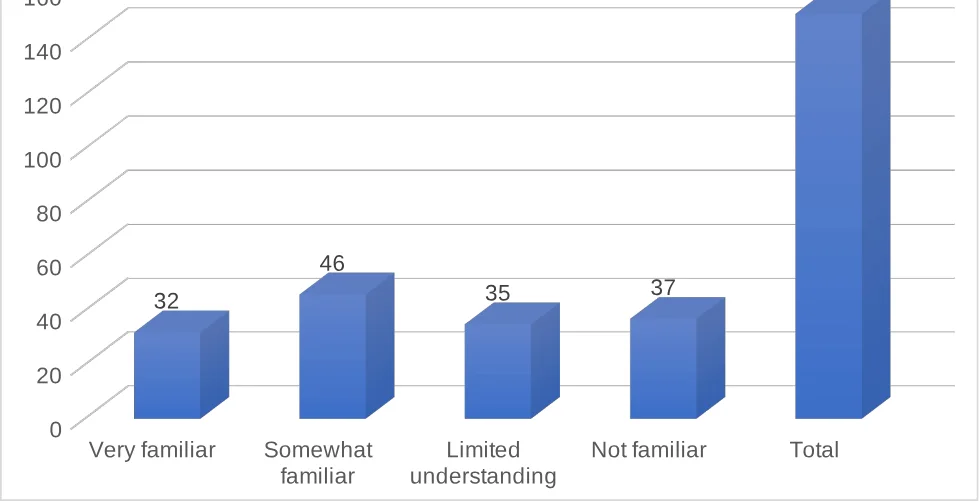
Results of the questionnaire show that there is a moderate level of awareness of Global Englishes among the teachers who participated in the survey. The participants were requested to give the measure of their knowledge on the concept of Global Englishes or World Englishes. The answers indicate that educators have different levels of knowledge regarding the concept with some strongly familiar with the concept and others having no previous knowledge. These results indicate that despite the fact that it is slowly becoming a conversation in the pedagogy of education, many teachers are yet to grasp the concept of Global Englishes as a theoretical framework of English language teaching.
In Figure 3, the distribution of the teachers in terms of their level of familiarity with the concept of Global Englishes is shown. The statistics reveal that different degrees of awareness are present among the teachers and that some respondents have good knowledge on the concept whereas others have small or no knowledge. The table gives the mathematical foundation of the graphical presentation that exists in the following figure.
Figure 3.Teachers’ Awareness of Global Englishes
5.3 Exposure and Classroom Practices to Variants of English
The questionnaire also focused on how far the teachers apply the various forms of English in the classroom. The findings point to the fact that exposure to various accents and varieties of English in classroom teaching is moderate but with a slow but steady rise among the English language teachers in Bangladesh. Although most teachers still use Standard English as a main model of instruction, a new trend is observed, where teachers start to introduce the examples of other English accents and other contexts of communication across the globe in their teaching courses.
The teachers indicated that they used different strategies to expose the students to the diversity in the English language, such as listening materials in multimedia, online videos, discussing international communication. Nonetheless, a large number of the participants mentioned that the standards of specific curriculum and the system of exams continue to focus on Standard English norms, especially in grammar and writing classes. Consequently, the teachers tend to strike a balance between the conventional language norms and little exposure to other forms of the English language during classroom events.
Table 5. Teachers’ Classroom Exposure to Different English Varieties
Classroom Practice
Frequency
Percentage
Regularly introduce different English accents
28
18.7%
Occasionally introduce different English varieties
69
46.0%
Rarely include different English varieties
34
22.7%
Do not include different English varieties
19
12.6%
Total
150
100%
Table 5 depicts the frequency of classroom practices of the teachers concerning exposure to various varieties of the English language. The statistics show that though some teachers habitually use different accents and varieties of English, most are likely to use them, on the rare occasions. A lesser number of teachers either seldom or never use such exposure in their teaching process. These findings indicate that even though there is the growing awareness of the diversity of English language, there is still a little integration of Global Englishes in the classroom instruction.
5.4 The Pedagogical Decision-Making of Teachers
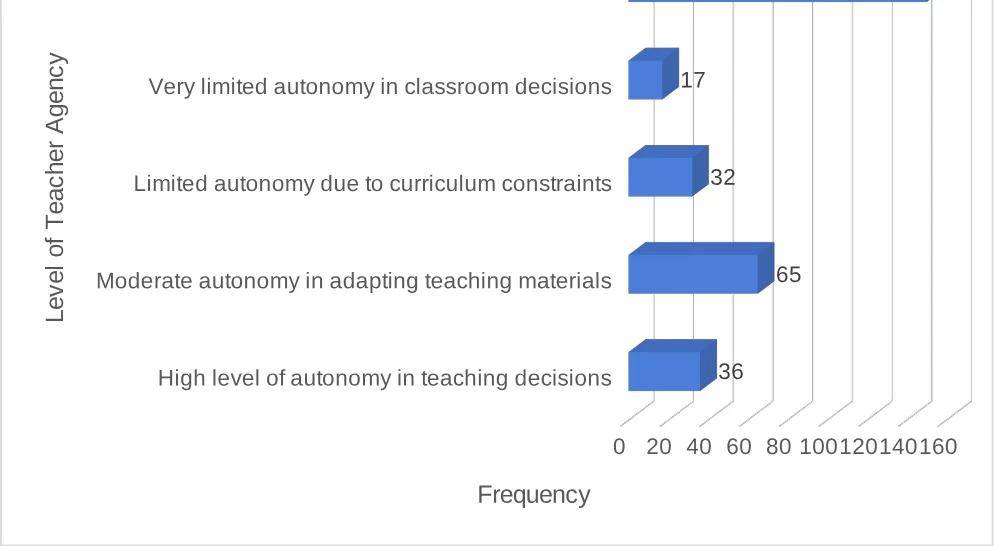
The paper also analyzed how teachers are exercising agency when it comes to making pedagogical choices concerning English language teaching. The capability of teachers to make interpretations of curriculum instructions, choice of teaching content, and altering instructional behavior in response to classroom demands is known as teacher agency. The results indicate that although most teachers have a certain level of autonomy in teaching activities, the choice of pedagogy is frequently determined by school policies, curriculum and examination standards.
According to many of the participants, they moderately have the flexibility to select teaching resources and teaching strategies especially when it comes to speaking and listening activities. And yet teachers also reported that the focus on standardized tests and formal writing proficiency tends to restrict their capacity to give full attention to the different varieties of English in classroom teaching. Consequently, educators often strive to reconcile curriculum demands and new pedagogical strategies that mirror the use of English in the world.
Figure 4 gives the perception of the teachers on their degree of autonomy in making pedagogical decisions. According to the results, most of the participants have moderate levels of agency, which enables them to modify some teaching materials and activities. Nonetheless, a significant percentage of the teachers stated that they had a restricted amount of autonomy because of curriculum demands and test pressures. These results indicate that although teachers are somewhat free in the classroom practices, institutional structures still cause them to be limited in their capacity to implement innovative classroom practices like Global Englishes in teaching English.
Figure 4.Teachers’ Level of Agency in Pedagogical Decision-Making
5.5 Pedagogical Uptake Insights of Interview
The results of the interview give a better understanding of how the teachers translate their beliefs to the classroom practice. Most participants demonstrated their favorable attitude to the exposure of students to the various forms of English and recognized the necessity of training the learners to communicate in the global environment. Some of the teachers said that they sometimes use different accents of the English language and example of international communication by way of listening activities, multimedia materials, and discussions on the use of the language all over the world. Nonetheless, the respondents also mentioned that the choice of pedagogical practice is frequently affected by curriculum demands and assessment systems, which are still focused on the norms of Standard English, especially in teaching grammar and writing. Therefore, a majority of teachers practice a middle way system, whereby Standard English is the main system of instruction and exposure to other forms of English is brought up in the form of additional activities. These results indicate that despite the slow nature of the emergence of pedagogical uptake of Global Englishes in the Bangladeshi ELT classrooms, their application is highly contingent on teacher professional agency and the institutional limitation.
6.Discussion
6.1 The further prevalence of Standard English in ELT
The results reveal that Standard English is still in operation as the main model of instruction in English language teaching in Bangladesh. To a great extent, the teachers view British or American English as the right standard of academic communication, formal writing, and academic success in exams. This understanding indicates the long-standing role of the conventional ELT practices in the education system whereby grammar correctness, standardized speech and the observance of the laid down language norms are both promoted in the school curricula and the assessment system. Consequently, educators in most cases favor Standard English in the learning environment especially when training students towards examinations and academic challenges.
6.2 Increasing popularity of the English language worldwide
Although still focusing on Standard English, the findings also indicate that more and more teachers are becoming aware in terms of the global nature of English. Due to the rapid development of online communication, distance education and media, learners are now conveniently exposed to numerous forms and versions of accents of the English language. Numerous educators acknowledge the fact that English is often employed as a common language among the representatives of various languages and cultures. As a result, there are teachers who think that learners ought to be taught to acquire skills of perceiving different English accents and communication patterns so as to be able to engage in international settings.
6.3 Teacher agency role in classroom practices
The results also indicate the significance of teacher agency in the process of defining classroom practices. It was found out that most teachers claimed to make efforts to provide various accents and foreign examples of English communication in terms of listening, multimedia, and a classroom talk. As an illustration, in certain cases, teachers play international news programs, educational videos on the internet, and taped discussions with speakers of other nations to expose the students to diverse forms of English. Such practices show that educators are engaged in bargaining between the traditional language norms and the new outlooks focusing on the English language as a global one.
6.4 Pedagogical barriers to institutional change
The structural and institutional limitations that hinder the implementation of Global Englishes perspectives by teachers in classrooms have not been addressed fully. The guidelines on curriculum, examination systems and teaching materials in use usually still focus on the Standard English especially in grammar, vocabulary and written communication. As the situation with the academic performance of students is mostly assessed using standardized examinations, the teacher might be compelled to pay attention to the forms of English that meet the requirements of the assessment. Consequently, despite the potentially held personal beliefs about the significance of linguistic diversity, the teachers tend to carry on with their classroom practices that are in line with the conventional requirements.
6.5 A transition phase in the English language teaching
The results indicate that English language teaching in Bangladesh is going through a slow process. Although institutional practices in the English language are still dominated by Standard English, there is an increasing trend to recognize the global nature of the English language and the requirement to equip students with multilingual and multicultural communication skills. Teacher agency, curriculum development and overall changes in education policy will therefore have to interrelate in terms of the effective inclusion of Global Englishes perspectives in ELT. Increased teacher training programs, revision of teaching resources and more adaptable pedagogies could be useful in facilitating this shift and encouraging a more inclusive perception of English language use in the classroom.
7.Conclusion
This paper has analyzed the extent to which English language teachers in Bangladesh view the domination of Standard English and the ways teachers integrate the views of Global Englishes in their teaching activities. The results indicate that in majority of the ELT classrooms Standard English has remained the major instructional model. But instructors are increasingly appreciating the need of introducing students to different varieties of English so that they become ready to communicate on a globalized basis. The introduction of Global Englishes in classroom teaching is still limited despite the willingness of the teachers to open up the world perspective in the teaching classroom, the problem is the limited nature of the curriculum, examination systems and institutional demands.
The teacher agency is one of the critical mediation factors that enable the educators to adjust the teaching practices within the framework of the existing educational frameworks. The analysis indicates that the appreciation of English as a global and heterogeneous language is slowly coming into the Bangladeshi ELT arena. Nevertheless, more institutional and pedagogical transformations are required to facilitate effective implementation of Global Englishes in English language teaching. Increasing teacher education programs, changing curriculum instructions, and including different versions of the English language in learning resources could be a useful step to make such a transition and involve the learners in a more effective process of mastering communication in foreign nations.
8.Recommendations
On the basis of the study findings, there are a number of recommendations that can be suggested to facilitate the successful adoption of Global Englishes approaches in teaching English languages in Bangladesh.
First, the teacher education and professional development programs must comprise the training on Global Englishes and the linguistic diversity. Offering the teachers theoretical knowledge and practical strategies regarding the varieties of English worldwide may contribute to their awareness and confidence in using different forms of English in classroom teaching.
Second, to make English language education and teaching programs and materials more globally oriented, the curriculum developers and policymakers are to be taken into consideration. To achieve that, it may be wise to provide students with an example of various English accents, communication situations, and the use of the English language in an international context.
Third, assessment systems ought to focus more on communicative competence and intelligibility as opposed to the environment based on native-speaker norms. These changes would enable teachers to be flexible in their approaches to bring about different varieties of the English language and communicative practices within the classroom.
Lastly, the future research must examine the perception that students have about the various variety of the English language, and how international views of the English language, of Global Englishes, affect the learning results. Additional research at higher levels of education and institutions can shed more light on how the teaching of English language can be more and more responsive to the linguistic realities of international communication.
Reference
Alam, Ashraf, and Atasi Mohanty. 2023. “Cultural Beliefs and Equity in Educational Institutions: Exploring the Social and Philosophical Notions of Ability Groupings in Teaching and Learning of Mathematics.” International Journal of Adolescence and Youth 28(1):2270662. doi:10.1080/02673843.2023.2270662.
Alsolami, Eman Hamdan Mohji. n.d. “Navigating Teachers and Students’ Ideological Stances on Monolingual Pedagogy and Native-Speakerism : Fostering Translanguaging in English for Academic Purposes Classrooms ; an Exploratory Case Study of a Saudi University.”
Ashton, Karen. 2022. “Language Teacher Agency in Emergency Online Teaching.” System 105:102713. doi:10.1016/j.system.2021.102713.
Boonsuk, Yusop. 2026. “When EFL Meets ELF: Negotiating Intelligibility and Intercultural Communication in ASEAN EMI Classrooms.” Language Awareness 0(0):1–31. doi:10.1080/09658416.2026.2626503.
Boonsuk, Yusop, and Ali Karakaş. 2025. “Teacher Education for Global Englishes: Preparing Educators for Linguistically Diverse Classrooms.” Pp. 57–89 in Global Englishes and Language Policy: Implications for Curriculum and Assessment, edited by Y. Boonsuk and A. Karakaş. Cham: Springer Nature Switzerland.
Chen, Rainbow Tsai-Hung. 2022. “Effects of Global Englishes-Oriented Pedagogy in the EFL Classroom.” System 111:102946. doi:10.1016/j.system.2022.102946.
Cong-Lem, Ngo. 2024. “Teacher Agency for Change and Development in Higher Education: A Scoping Literature Review.” International Journal of Educational Reform 10567879231224744. doi:10.1177/10567879231224744.
Gandana, Isti Siti Saleha, and Fuad Abdul Hamied. 2025. “English as a Lingua Franca (ELF), Interculturality, and Identity.” in The Routledge International Handbook of English Language Education in Indonesia. Routledge.
Guo, Ziyue, and Sandeep Sidhu. 2024. “From Identity Unbecoming to Becoming: Duoethnography of Multilingual and Multicultural English Language Teacher Identities.” System 121:103246. doi:10.1016/j.system.2024.103246.
Heidari Tabrizi, Hossein, and Azizeh Chalak. 2025. “Cultural Conceptualizations of Friendship in Locally Developed English Textbooks for Iranian ELT Institutes.” Pp. 129–56 in Cultural Linguistics and ELT Curriculum, edited by M. Alemi and Z. Tajeddin. Singapore: Springer Nature.
Kopchak, Liliia, Marianna Zhumbei, Liubov Terletska, and Kateryna Konchovych. 2022. “The Use of English as a Lingua Franca to Overcome Language Barriers and Raise the Level of Education in Modern Conditions.” Eduweb, Revista de Tecnología de Información y Comunicación En Educació 16(3):121–33.
Larsen, Eivind. 2024. “Mission and Mandates: School Leaders’ and Teachers’ Professional Discretion in Enacting Education for Democracy.” International Journal of Leadership in Education 27(3):661–85. doi:10.1080/13603124.2021.1893390.
Li, Gang, and Yan Ma. 2025. “Exploring the Influencing Factors of Teacher Beliefs and Their Impact on Teacher Behaviors.” BMC Psychology 13(1):993. doi:10.1186/s40359-025-03095-z.
Liu, Wenxia, and Yunsong Wang. 2024. “The Effects of Using AI Tools on Critical Thinking in English Literature Classes Among EFL Learners: An Intervention Study.” European Journal of Education 59(4):e12804. doi:10.1111/ejed.12804.
Monfared, Abbas, and Rasool Najjarbaghseyah. 2023. “An Investigation of Learners’ Attitudes towards Pronunciation and Emerging Varieties of English in Outer and Expanding Circle Countries.” Iranian Journal of Applied Language Studies 15(1). doi:10.22111/ijals.2023.7568.
Moody, Andrew J. 2024. The Oxford Handbook of Southeast Asian Englishes. Oxford University Press.
Nam, Hyunjeong. 2023. “Challenges and Constraints of Implementing Communicative Language Teaching: Teacher-Related vs. Non-Teacher-Related Factors.” LEARN Journal: Language Education and Acquisition Research Network 16(1):75–96.
Neupane, Bharat Prasad. 2024. “Sociocultural Environment and Agency in Identity Construction of English Language Teachers.” The Qualitative Report. doi:10.46743/2160-3715/2024.6756.
Rokaiya, Ummeh, and Norzihani Saharuddin. 2022. “Exploring Communicative Language Teaching to Enhance Grammatical Knowledge among Secondary School Students in Bangladesh.” Journal of Public Administration and Governance 12(4S):1. doi:10.5296/jpag.v12i4S.20564.
Rose, Heath, and Nicola Galloway. 2019. Global Englishes for Language Teaching. Cambridge University Press.
Salomone, Rosemary, and Rosemary C. Salomone. 2022. The Rise of English: Global Politics and the Power of Language. Oxford University Press.
Selvi, Ali Fuad, Nicola Galloway, and Heath Rose. 2023. “Teaching English as an International Language.” Elements in Language Teaching. doi:10.1017/9781108902755.
Syam, Christanto, Sesilia Seli, and Wamaungo Juma Abdu. 2023. “Dynamics of Language Interaction in Multicultural Urban Communities: Analysis of Socio-Cultural Linguistic Environment.” Society 11(2):575–88. doi:10.33019/society.v11i2.628.
Yan, Qianwen, and Hongmei Ruan. 2024. “Exploring Standard English: Its Superposed Variety, Historical Development, and Social Implications.” International Journal of Social Science and Humanity. doi:10.18178/ijssh.2024.14.2.1197.
CITE THIS ARTICLE
Sultana, S. (2026). Decentring Standard English in ELT: Teacher Agency and Pedagogical Uptake of Global Englishes in Bangladesh. https://www.researchbysayma.com/article/0dd93608-057c-45dc-ad77-2fd4b8d3115f
S. Sultana, “Decentring Standard English in ELT: Teacher Agency and Pedagogical Uptake of Global Englishes in Bangladesh,” 2026. [Online]. Available: https://www.researchbysayma.com/article/0dd93608-057c-45dc-ad77-2fd4b8d3115f
Sultana, S. (2026) ‘Decentring Standard English in ELT: Teacher Agency and Pedagogical Uptake of Global Englishes in Bangladesh’. Available at: https://www.researchbysayma.com/article/0dd93608-057c-45dc-ad77-2fd4b8d3115f
Sultana, Sayma. “Decentring Standard English in ELT: Teacher Agency and Pedagogical Uptake of Global Englishes in Bangladesh.” 2026, https://www.researchbysayma.com/article/0dd93608-057c-45dc-ad77-2fd4b8d3115f.
Sayma Sultana. “Decentring Standard English in ELT: Teacher Agency and Pedagogical Uptake of Global Englishes in Bangladesh.” (2026). https://www.researchbysayma.com/article/0dd93608-057c-45dc-ad77-2fd4b8d3115f.
Sultana S. Decentring Standard English in ELT: Teacher Agency and Pedagogical Uptake of Global Englishes in Bangladesh. 2026. https://www.researchbysayma.com/article/0dd93608-057c-45dc-ad77-2fd4b8d3115f
@misc{article_0dd93608057c45dcad772fd4b8d3115f,
  title = {Decentring Standard English in ELT: Teacher Agency and Pedagogical Uptake of Global Englishes in Bangladesh},
  author = {Sayma Sultana},
  year = {2026},
  url = {https://www.researchbysayma.com/article/0dd93608-057c-45dc-ad77-2fd4b8d3115f},
}
TY  - GEN
AU  - Sayma Sultana
TI  - Decentring Standard English in ELT: Teacher Agency and Pedagogical Uptake of Global Englishes in Bangladesh
PY  - 2026
UR  - https://www.researchbysayma.com/article/0dd93608-057c-45dc-ad77-2fd4b8d3115f
ER  -
Generative artificial intelligence (GenAI) can provide quick formative feedback, but it is only effective if it is governed to recognize false or biased results while retaining valuable feedback. A synthetic multisite benchmark was used to analyze a total of 2,700 repeated records from 900 simulated students and 54 simulated teachers, across three different delivery methods: AI-only delivery, conventional teacher review, and structured teacher oversight. The main endpoint was delayed transfer, e
Generative artificial intelligence (GenAI) is increasingly being used in language assessment, formative feedback, tutoring, translation, and writing support, most assessments focus on accuracy, on user perception, or on short-term performance. This study creates a cross-national benchmark for assessing responsible AI in four areas: validity, equity, privacy and pedagogical value. The analysis was based on a secondary data set made publicly available and comprising 960 analysis-ready learner-prof
This study investigates the policy-practice gap associated with TESOL through the case of Bangladesh and New Zealand by analyzing the influence of teacher thinking, curriculum congruity, and situation. A comparative study indicates that there is a considerable difference in teacher knowledge and classroom practices. In Bangladesh, teacher policy knowledge was high among only 28 per cent of teachers, teachers had 53 students on average per class. There were limited resources and an insufficient s